


The Fish of the Year 2026 voting has begun!
The Hungarian Haltological Society has been announcing the “Fish of the Year” election every year since 2010 to promote our native fish species. While in the first year the Society’s presidency made the decision, from 2011 the final say belongs to anglers and nature lovers: three candidates are nominated and online voters select the winner.
The 2026 Fish of the Year title will be won by the species that receives the most votes.
The vote and the candidates can be found on the website of the Hungarian Marine Society or by clicking here.
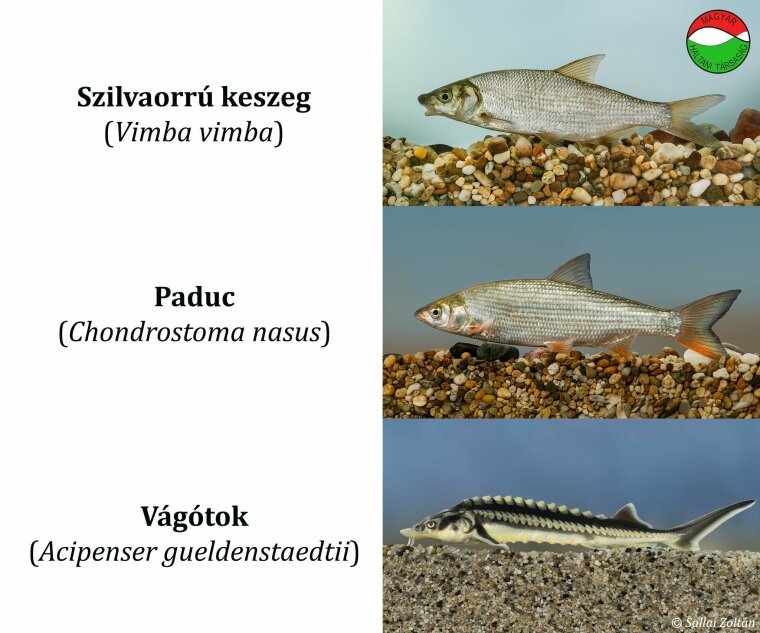
Nominees for the 2026 Fish of the Year title:
- Plum-nosed bream (Vimba vimba):
The plum-nosed bream, or Vimba vimba by its scientific name, is a fish belonging to the family of breams. It is characteristically elongated, flattened from the sides, with a moderately high back. Its snout is long, extending well forward of the upper jaw, and its color is typically darker than the base color of the fish, with a grayish-purple hue. Its mouth is U-shaped when viewed from below, its lips are rounded, and this, along with the long subcaudal fin, distinguishes it well from its other similar candidate, the bream. Its scales are small, numbering 52–62 on the lateral line, and they form a serrated, metallic-shiny edge between the dorsal and caudal fins. Larger specimens are 20–30 cm long, but can reach up to 40 cm. It is a rheophilic, i.e. flow-loving, native fauna element, and is most common in the barbel zone in larger rivers. Its reproduction lasts from May to July, when a migration can be observed in the domestic population up the rivers, where it lays its eggs on the washed gravel-pebble bed material. Ottó Herman still mentions it as Éva bream, which is rarely used, but is still used today. Its population is decreasing throughout Europe with the disappearance of fast-flowing habitats. /Dénes Bajcsev-Dancsó
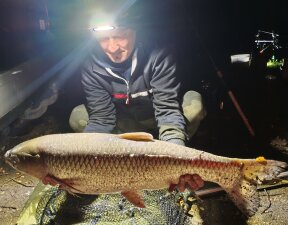
- Loach (Chondrostoma nasus)
The humpback (Chondrostoma nasus) is a native European fish species with an elongated body, slightly flattened from the sides. Its head is relatively small, with a blunt snout extending in front of the mouth. The slit of its lower mouth is transverse, the edge of its lower lip is covered with a horny coating, which makes it sharp and hard, and when viewed from below it is almost straight. Its dorsal and pelvic fins are in line, its subcaudal fin is of medium length, and its caudal fin is quite large and deeply incised. Its scales, of which 55–66 are located along the lateral line, are relatively small.
It roams in groups, its food in its young age is composed of planktonic organisms, like almost all domestic fish, but later it consumes live cover in a unique way in our country, which it scrapes off stones and other underwater objects with the help of its chisel-like lower lip. Spawning takes place in April-May in the more turbulent sections of the rivers, the eggs stick to the gravel bed, and the fry hatch here later. It is a river fish, it prefers oxygen-rich water. It is most typical of the paduc zone named after it, for example, the section of the Upper Tisza above the Tiszacsécse belongs to this level region, but it is common in the barren zone, and it also occurs in the slower-flowing sedge zone. Its meat is stringy, but tasty when cooked well. It is a hard-fighting fish popular with anglers. The domestic record catch is 3.02 kg. / Sereg Kamilla Rózsa
- Acipenser gueldenstaedtii (Acipenser gueldenstaedtii)
The gueldenstaedt (Acipenser gueldenstaedtii) is a representative of the ancient-looking sturgeon family that also occurs in our country. Its snout is short, blunt, its whiskers do not reach the upper lip, its body is elongated, and its sides and back are lined with large and sharp scales, which are especially noticeable on young specimens. It also got its name from these scales, as even a careless movement can be enough to injure a person's skin.
As a migratory fish living in the sea, it used to visit rivers only during the breeding season to scatter its eggs on the open, gravelly riverbed, but the construction of the Iron Gate posed an insurmountable obstacle to its migration route. It grows large, and the length of older specimens can exceed two meters. In Hungary, a specimen is found from time to time, but these are presumably from planting. It still occurs regularly among the catches of some coastal countries, but in our country, unlike its cousin, it probably does not have a self-sustaining population. Its protection serves the settlement of the planted specimens./László Nagy
Let's vote as many as possible to decide together which species will be the 2026 Fish of the Year!